2022-23 DoIT Annual Report
In 2022-23, we fully turned our effort away from pandemic-related projects to forward-looking work across the breadth of academic and administrative priorities of the university, as well as toward the continuing IT operations that support the work of the university. It was the right time to assess our priorities, and through an engaged process across the university, we established new priorities in 5 key areas: people, research, teaching and learning, administrative transformation and cybersecurity. I’ve noted examples of progress and plans for the coming year for each priority in this report.
The Division of Information Technology (DoIT) delivered IT operations and services to the university, consistently meeting established benchmarks for service performance. While our IT operations are too extensive to capture here, I’ve included a few highlights in this report. Notably, we’re all incredibly proud that the university recognized several divisional staff for their outstanding contributions at this year’s Administrative Improvement Awards and University Staff Recognition Awards. The university honored the Cloud Computing Infrastructure team for their work to dramatically ramp up the capacity and performance of the university’s cloud infrastructure while slashing costs to university customers by 45%, and a DoIT staff member who was part of a Human Resources-led team that reduced the data entry time for new hires and rehires from 5-6 minutes per employee to 1-2 minutes while reducing data entry errors. A member of the printing service was recognized for professionalism and skill. These awards demonstrate how we have embraced continuous improvement and stepped up as a partner to help others as well.
Throughout the year we had no major data loss due to cybersecurity attacks, though we did experience a denial of service attack in spring. We have since implemented new tools and processes to minimize the impact of future attempts against the network, though we know there is more to do. Given the increasing threat levels, sophistication, and innovation in the marketplace, we continue to evolve our cybersecurity practice and we are implementing a “Smart Access” strategy to provide additional layers of security.
This summer, in partnership with the Data Science Institute, we are hosting a webinar series on artificial intelligence (AI), which aims to inform and elevate the conversation on campus about the power, possibility and cautions of AI use. Featuring our faculty and industry speakers, the webinars will cover topics ranging from research into and using artificial intelligence to AI in the classroom to health care, bias and ethics issues and more.
Finally, DoIT is partnering with Babcock Dairy, UW–Madison’s premiere dairy research plant and the creator of many beloved ice cream treats, to create a special, limited-edition ice cream flavor. “Bits & Bytes,” featuring vanilla ice cream with bits of cookie and “bytes” of brownie intermixed, celebrates DoIT’s 30th anniversary next year.
It is my privilege to share the progress and successes of the Division of Information Technology on behalf of the staff who have accomplished this work.
—Lois Brooks, UW–Madison chief information officer & vice provost for information technology

Progress and plans toward our priorities

Through an engaged and collaborative process, I have identified 5 strategic priority areas for the IT enterprise at UW–Madison. I’ve included progress highlights and plans for the coming year with each priority area.
People
People do the work of the university, including IT, and their engagement, well-being and productivity are our top priority.
Primary goal
Foster an inclusive and diverse IT community through purposeful efforts to recruit and retain a diverse workforce and to ensure a welcoming culture that encourages a sense of belonging and fosters respect.
Select accomplishments
- We have seen substantial improvement in the number of job applicants by using new channels. For example, we have seen a 47% increase in diversity in the applicant pools in 2023 using LinkedIn Recruiting.
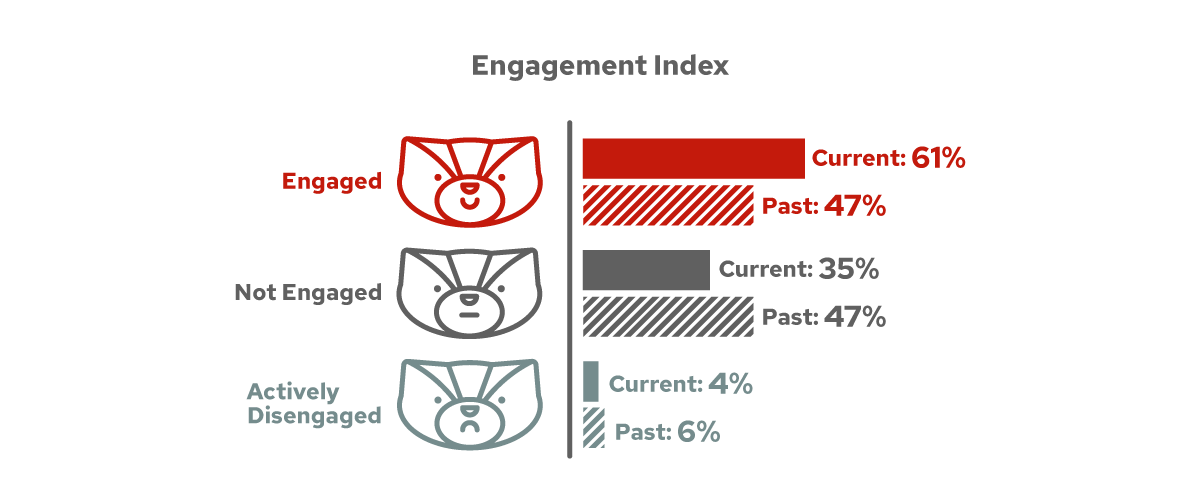
- We have prioritized improving our workplace climate for the past 2 years, with focused effort from each team to work on a climate and engagement goal specific to their team. Our 2023 survey showed improvement in every category over 2021, evidence that our efforts are effective. Notably, engagement has substantially improved over the past 2 years.
- We developed and are leading the implementation of new digital accessibility standards to ensure access for all members of our community to tools and resources for working and learning.
- The division sponsors UW–Madison IT Connects, a collaborative, grassroots organization that provides conferences, events, workshops, professional development and communities of practice for the university-wide information and technology community. The most recent IT Professionals Conference in June drew in 479 attendees from the university’s IT community.
- We engage with MOR Associates to offer leadership training for IT professionals across the university. This year, 58 staff participated in programs to develop their potential. A total of 278 have been through the program since it began.
Priorities in the coming year
- Create a new leadership position in the Division of Information Technology: assistant vice provost for climate, culture and engagement. This person will further our work in creating a diverse and inclusive work environment where everyone can flourish and feels like they belong. They will also help us build pipelines for talent and bring their expertise in equity, diversity, inclusion and belonging to the division’s leadership level.
- Continue the ongoing work to improve climate and engagement to ensure that each person can do their best work and contribute fully.
- Support the inaugural hires from UW–Madison’s 1st-ever IT Job Rotation Program, in partnership with the Office of Human Resources.
Research
We have prioritized research cyberinfrastructure and support for several years because UW–Madison was at a competitive disadvantage compared to our peers. The university has made substantial investments in computation and storage, and we’ve actively engaged with the major research computing services at the university to work in a collaborative and coordinated manner.
Primary goals
- Create a coalition to enhance and expand services that enable researchers to leverage university computing, storage and cloud-based services.
- Increase researchers’ awareness and use of research cyberinfrastructure services, training and communities of practice.
- Lower barriers of entry to research and collaboration; focus on improving research cyberinfrastructure alignment with university/research administration.
Select accomplishments
- ResearchDrive is a centrally funded storage solution for research data storage, providing an allocation to all campus research principal investigators (PIs). We expanded the service to provide 25TB funded storage to each PI, with more functionality and additional capacity at a lower cost.
- Through substantial investment from the university, the Wisconsin Alumni Research Foundation and the Office of the Vice Chancellor for Research and Graduate Education, we facilitated a major refresh and upgrade of the aging computational capacity of the Center for High Throughput Computing. This one-time investment also provided support for facilitators to work with researchers. The investment provides 2.5 years of operational funds, allowing time to develop a long-term, sustainable financial model. Our work helped enable scientific achievements, including new rendering images of the supermassive black hole at the center of the Milky Way.
- Vice Chancellor Steve Ackerman and Chief Information Officer Lois Brooks convened a new faculty Advisory Committee on Research Computing to provide advocacy for research computing at the university.
Priorities in the coming year
- Develop a financially sustainable model for research computing.
- Continue to advance the coalition of research computing service providers across the university, including the new PlatformX for work hosted by the School of Medicine and Public Health. Nurture and build on the partnerships, communities of practice and research computing governance groups formed to help create connections and provide advice on existing and future needs.
- Operationalize the recent campus investment in research data storage, increasing adoption and visibility while matching storage needs to the research data lifecycle.
- Thoughtfully expose and enhance the use of artificial intelligence tools in research computing.
- Anticipate, plan and respond to the dynamic policies of local, state and federal mandates affecting cybersecurity in research computing environments.
- Provide the infrastructure, tools and training necessary to operate research computing environments in the public clouds, lowering barriers to entry and taking advantage of pricing incentive programs.
Learner success
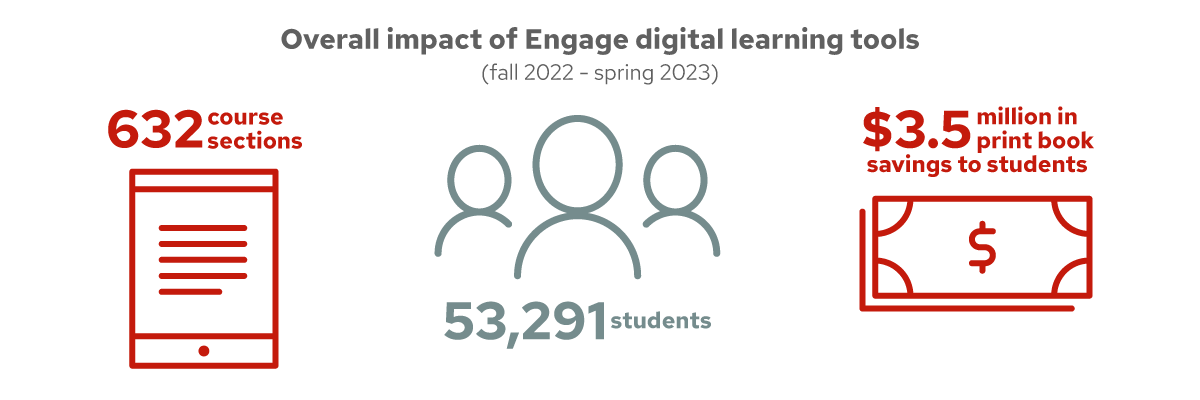
DoIT’s Academic Technology group provides services and tools that directly support the teaching, learning and research mission of the university. UW–Madison has a robust digital learning environment, with close to 200 tools integrated into Canvas to provide a personalized learning environment at scale. Working in collaboration with Vice Provost John Zumbrunnen and the Division for Teaching and Learning, we have prioritized data-empowered education. Our engagement with the Unizin consortium provides access to a universal data platform giving us access to tool data that powers learning analytics, as well as access to low-cost digital course materials.
Primary goal
Provide a contemporary, personalized environment for learners and instructors to teach and learn, collaborate and connect while enhancing analytics to foster success.
Select accomplishments
- In FY23, the DoIT Learning Analytics Center of Excellence (LACE), in collaboration with the Division of Teaching and Learning, launched its inaugural diversity, equity, inclusion and belonging (DEIB) microgrants program to support faculty in exploring how learning analytics can support diversity, equity, inclusion and belonging in the classroom. Results from the 4 selected projects were presented at the 2023 Teaching and Learning Symposium.
“This program has turbo-charged my goals of making change happen in my department. I’ve worked with great people from [the microgrant team] who have inspired me to do things beyond my previous comfort level. Based on my reporting out this research to my department, I’ve been connected with department leadership and our director of corporate relations. This mini-grant has had an immediate, tangible impact on our department’s DEIB efforts. We’ve made 3 years of progress in just 1 semester.”
- The Learn@UW–Madison team, supporting the suite of teaching and learning tools for the university, expanded the NameCoach service. Now anyone at UW–Madison can use NameCoach to share their name pronunciation. This is one small step to improve our welcoming environment and enable individuals to flourish at UW–Madison.
- All seniors in the Information Technology Academy, our pre-college program serving Lac du Flambeau, Oneida, and underserved communities in Madison, graduated from the program and nearly all have opted to attend college, with about half selecting UW–Madison.
- Academic Technology collaborated with the Office of Human Resources and the Office of Compliance to add non-credit instructional design services to the Learn@UW–Madison service. This team creates online training for employees and students to support activities in the Office of Compliance, the Office of Human Resources, and University Health Services among others.
- AT’s Teaching and Research Application Development group (TRAD) partnered with researchers to develop applications supporting an applied research program for farmers market managers focused on social theory, organizations, law, food systems and economic development; research focused on understanding multiple co-occurring symptoms (symptom clusters) and interventions to improve symptom control and quality of life in persons with cancer; the development of adapted treatment depression interventions; and research to support the development of strategies for ameliorating threats to endangered wildlife.
Priorities in the coming year
- Serve as the university’s innovation incubator and technology partner, providing tools, thought leadership, analytics and support as data-empowered educational practices and programming continues to develop.
- Launch the 2nd faculty cohort of diversity, equity, inclusion and belonging microgrants.
- Modernize the teaching and learning data and infrastructure to advance and support the next generation of teaching and learning tools and initiatives.
- In support of the UW–Madison Digital Accessibility Policy, continue building the digital accessibility liaison network to enable schools, colleges, divisions and units to incorporate accessibility as part of their work and improve the accessibility of digital resources and tools throughout the university.
- In partnership with the Dean of Students, offer student resources in MyUW and Canvas that promote the visibility of student wellness and assistance resources.
- Collaborate with the Office of Human Resources to prepare UW–Madison non-credit training and compliance course owners to move employee training content from Canvas to the new Workday Learning Management System.
- Anticipate and respond to federal mandates impacting systems supporting the admissions process, pre-college programs and 3rd party servicers.
Administrative transformation
We are supporting the implementation of the university’s Administrative Transformation Program (ATP) and its surrounding projects. An effort of this magnitude always includes challenges, and this spring UWSA and university executive sponsors took decisive action to bring the project back on track. This course correction included recognizing the essential work needed beyond implementing Workday, including updates to ancillary systems, business process management and downstream data warehousing. They tapped DoIT Enterprise Business Systems Director Adam Paulick to oversee and coordinate this critical work with additional support and project oversight from Lois Brooks as an executive sponsor.
The division has 2 distinct relationships to this project. We serve as an implementation partner and the IT organization of the university, enabling project success. We are also a customer, and have substantial work to prepare ourselves for a successful migration to Workday from our existing systems and processes.
Strategy 1: Implement and support the ATP transition to successful completion.
Strategy 2: Support systems across the university that become obsolete or lose access to data as ATP is implemented, and modernize infrastructure needed to operate business operations in the new enterprise.
Selected accomplishments
- Starting in February 2022, we began analyzing the nature and disposition of the university’s ancillary systems (those that integrate or share data with PeopleSoft Finance and HR, or have duplicate functionality). In that time, we identified 1,030 ancillary systems at Madison in 146 departments. After meetings and analysis with each group to determine a path forward, we determined that 75% will need to be touched to update data feeds and integrations, archive existing data, separate business functionality, etc.
- We enhanced the university’s interoperability environment in advance of ATP to enable integration in a modern and secure way. The ATP team decided to use the UW–Madison interoperability service for the entire project across all UW System schools.
- We assessed our own constellation of ancillary systems and business processes to prepare a path forward for the division to comply with ATP goals.
- We are launching a low-code/no-code platform that we will need to migrate some business functionality from an existing ancillary system to a modern and secure environment outside of Workday in the future.
- We are leading the coordination across the entire portfolio of ATP projects on behalf of the UW System.
Priorities in the coming year
- Accomplish all that we are charged with doing, along with the new work that constantly arises, to enable a successful conversion to Workday across the UW System, the university and within the division.
Cybersecurity
Cybersecurity is a national threat and an area of focus and activity at the university. While we have a mature cybersecurity practice, continual improvements in tools and techniques offer new opportunities, continual innovation by criminals demands that we adjust to block these threats. Hence, we are looking at updates to our cybersecurity infrastructure.
Primary goal
Extend the security framework to prevent, detect and manage threats across the university, encompassing all devices connected to the network or accessing university data, systems and processes.
Selected accomplishments
- We had no major data breaches in the past year. We experienced a denial of service attack, and as a result have implemented additional tools and protocols to minimize future risk.
- The division completed a major upgrade to university email security, moving to Proofpoint for anti-malware and anti-spam, which offers greater protection and gives us a greater ability to actively manage our security environment.
- We began moving toward a zero-trust architecture environment, which we’re calling “Smart Access.” As part of this effort, we have:
- Launched an intensive test phase of the Microsoft cybersecurity suite with an eye toward moving from our best-of-breed tools to an integrated approach to allow better visibility and telemetry.
- Hosted a series of engagements helping campus IT professionals learn about contemporary trends in cybersecurity methodologies. We formed a cross-functional working group to begin implementing methodologies as we continue to secure our diverse campus landscape.
- DoIT and university partners made substantial progress in improving the security of the distributed Active Directory environments across the university. We created a process for voluntary migrations from college-based active directories to the secure university environment. The university started with 62 active directories and is down to 50 remaining, with more migrations underway.
Priorities in the coming year
- Make substantial progress toward Smart Access. This is a multiyear effort spanning architecture, tool upgrades, new policy and processes.
- Fully secure all distributed Active Directory environments and make substantial progress on migration, which is currently a voluntary option.
- Finalize Microsoft evaluation and develop investment and implementation plans.

Services and operations
Our primary work is to provide the IT services the university relies on for all its activities. We measure our performance against industry standards with help from Gartner, and we consistently achieve our operational goals. Our work to continuously improve includes a strategic project to establish a foundational understanding of Lean principles to improve our throughput and lessen our employees’ stress by “making work visible.”
Select accomplishments
- We migrated approximately 1,100 servers supporting mission-critical IT services from aging on-campus data centers to more robust facilities with the State of Wisconsin and OneNeck IT Solutions. This migration ensures greater resilience for the IT services that support the business of the university. In the coming year we will partner with the Division of Facilities Planning & Management to develop a long-term data center strategy and sustainable funding model. The university currently has 95 distributed data centers and machine rooms.
- We launched a “name in use” service to allow people to declare the name they would like to be called and have that information reflected in Canvas, Zoom, email and more.
- The Administrative Information Management Services (AIMS) joined DoIT, and we have merged their methodologies into the division over the past 2 years, allowing us to take the best practices from each organization to improve services to our customers.
The Division of Information Technology serves as a partner to colleges and divisions across the university, and we are constantly working on projects that help others succeed. In addition to the examples I have noted throughout this report, here are a few highlights of our partnership activities in the past year:
- We worked to refresh the information technology infrastructure of University Health Services — a multiyear process.
- We collaborated with the School of Education to improve their processes, yielding an admit-to-enrolled ratio 17% higher than the campus average.
- Through our partnership with the Office of Business Engagement, they developed a comprehensive record of industry engagements across the university.
- The division teamed up with the UW Police Department, Facilities Planning & Management and the Office of Strategic Consulting to deliver a modernized, campuswide replacement for a 16-year-old building access system. The new system provides electronic security using Wiscards, giving the university granular control over access to spaces across campus. So far, we have helped to update 120 campus locations.
- The U.S. Department of Defense awarded $3.4 million in grant funding to the College of Engineering and DoIT’s Application Infrastructure Services and Web Platforms/Services to use mixed reality to analyze the potential for structural damage within historical structures.
We also are a service provider to the UW System Administration and UW System campuses, operating the technology that powers their financial and human resources needs, managing their statewide network, and hosting and administering student information systems for 9 UW System campuses.


By the numbers
Together with our IT partners and colleagues across the university, a snapshot of our
collaborative work:

Keeping the university secure
179,000
ticket requests processed by the Cybersecurity Operations Center (CSOC)
2,600
cyber attack reports responded to by the CSOC
37,851
vulnerability detection agents deployed (Qualys)—a 44% increase this academic year
40,391
protection agents deployed (Cisco)—a 34% increase this academic year
22,503
cybersecurity awareness trainings completed this academic year—includes 97% of faculty and staff eligible for the UW pay plan
120
cybersecurity security control reviews completed to reduce risk for campus units

Supporting the academic mission
*spring 2023 figures
42,944
active student users in Canvas
3,996
traditional for-credit courses in Canvas
464,580
items in Kaltura MediaSpace
120,924
HelioCampus AC course evaluations completed
15,903
Pressbooks users

UW’s digital campus
183 petabytes
(183,000,000,000,000,000 bytes) of typical monthly internet traffic
18,292
wireless access points on campus
82,700
average daily devices connected to campus wireless network (UWNet and Eduroam)

Help Desk and support
*fall 2022 to spring 2023 figures
68
Help Desk contactless locker equipment pickups
1,486
no-cost laptops checked out to students
138
hot spots rented to students
6,957
walk-in Help Desk cases completed
300+
on-campus partner groups represented in the UW–Madison KnowledgeBase (KB)