Provost shares insights on technology, leadership & UW’s interdisciplinary future
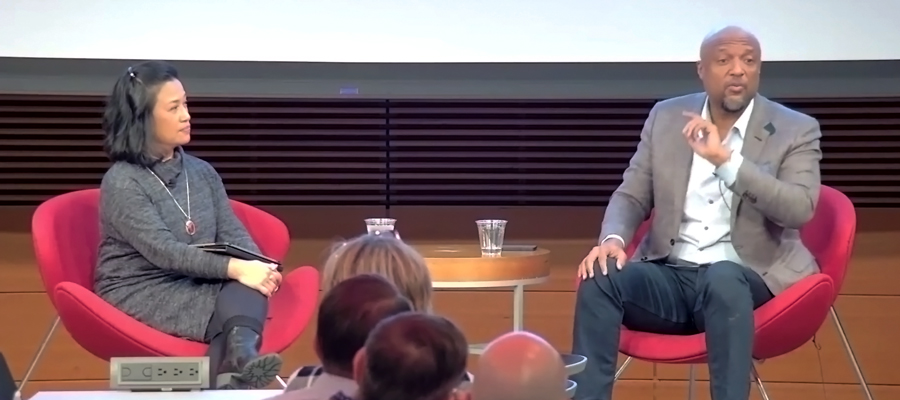
“What does it mean to be the elite public research university of the 21st century? What does it mean to take these things we knew how to do 175 years ago and translate them to 25, 30, 75 years into the future? … My fundamental belief is that we’re at a great place, and we want every single political, social and technological decision in the world to involve us. … There will be no conversation of any import in the world that doesn’t somehow trace its way back to the University of Wisconsin–Madison.”Read an edited and condensed transcript of the conversation below, or watch the full recording of the I&TLC fireside chat.
Welcome, and thank you for joining us, Provost Isbell. Now that you’ve had a few months under your belt here at UW–Madison, what are your first impressions? Any surprises?
Winter. Winter is a very big one. I spent most of my career in Atlanta and I was just thinking that this past November and 1st week of December is more snow than I have seen in any place that I’ve lived for over a quarter of a century. And I am told that it will keep happening over the next several months. I intend to remain in denial about that. So if you ask me anything about it, I’m just going to pretend it’s not happening. I should preface all of my remarks by saying this is an amazing university. It’s an amazing ecosystem outside the university itself. I knew that coming in, but it’s much broader and deeper than I actually expected or what it looked like from the outside. This is really an amazing place. But the inherent contradiction is 2 things that are happening at the same time that are in an interesting tension. There’s this amazing desire for impact and change, and to figure out how to take something like the Wisconsin Idea and really see it expressed out in the community and in the world, and to do whatever it takes to make that happen, on the one hand. But then also a kind of suspicion around change at the same time. The expression that I’ve heard the most in the last 4 months I’ve been here is, “But that’s the way we’ve always done it.” And that kind of tension is interesting. It’s an interesting place to figure out how to do more while still remaining who you are at heart — what your core values are — and appreciating that while understanding how it fits into where it is you want to go over the next several years.How would you describe your leadership style?
There’s what I think I do and how I’m perceived and how I do things, and then there’s everyone else in the world. And it’s unclear whether we agree with one another. The head of IT (at Georgia Tech) once gave me a little sticker based on a story that I told him, and it’s kind of a philosophical question. “If the entire universe tells you that you’re a potato, and you disagree, are they wrong, or are you an insane potato?” So he had custom-made this little sticker, which says, “Am I an insane potato?” which I keep on my desk and look at every once in a while to try to remind myself. I like to think I’m a sane potato, but beyond that, when I think about my leadership style, I think of myself as a change agent. If you’re going to be that kind of leader and bring people along, then it helps very much to have — and to constantly talk about — the core thing that you’re trying to do and what your core values are.I like to think of my style as trying to bring as many people along into these conversations as I can and create a space for people to talk honestly about what they’re thinking. But to always make certain that we understand where we’re going and why.Some of you will have heard of the big interdisciplinary hiring initiative that we’re embarking on. But there have also been discussions about changes around the budget model, revenue cycle management and capital planning. So we’re going to have lots of these conversations and initiatives. But the truth is, we are only doing 1 thing. The 1 thing that we’re doing is we’re trying to take this wonderful university, which is like an aircraft carrier, and we’re trying to move it from here to here [gestures with hands 6 inches apart]. We’re trying to take the fundamental notion of what the Wisconsin Idea is. What does it mean to be the elite public research university of the middle of the 21st century? What does it mean to take these things that we knew how to do 175 years ago and translate them 25, 30, 75 years into the future? What do we have to change? What do we have to keep the same? What do we have to make happen in order to maintain that? My fundamental belief is that we’re at a great place, and we want every single political, social and technological decision in the world to involve us. Because why not? It’ll be the people in this room. It’ll be faculty and staff and students and alums or friends. But there will be no conversation of any import in the world that doesn’t somehow trace its way back to the University of Wisconsin–Madison. And so, to me, a question of leadership style is really a question of what it is you’re trying to accomplish and how you communicate and bring people into the conversation. What gets me up in the morning, and I hope gets the people around me up in the morning, is the idea that all these little things that we’re doing, which seem disconnected, are actually fundamentally the same thing. Whenever there’s a decision to be made, we can simply ask: does it connect to the central thing that we’re trying to do, or is it irrelevant? And the answer to that question tells us what we do and tells us whether it’s worth it.
As provost, you have insight into both the academic and administrative functions of the university. How have you seen technology shape the student experience and faculty research over the years? What gets you most excited about future possibilities?
That’s an interesting question because it has a bunch of premises built into it. So let’s unpack it a little bit. There’s the question of how technology has affected us. How many people (are attending) online? 200, something like that? That wasn’t possible in any meaningful way 25 years ago or even 10 years ago. Everything would have broken down multiple times by now. Just that alone changes everything. We can bring people together, and we can think about things like what a campus looks like across both time and space. That’s a way of thinking about the world that didn’t even make sense an academic generation ago. It’s changed everything. Amara’s law says that we always overestimate the short-term impact of technology and underestimate its long-term impact. Go back to ARPANET and think about what that looked like in the ’60s and ’70s. Or take us to the World Wide Web in the early ’90s. “Oh, it’s going to change everything!” And it kind of didn’t (at first). I mean, we got blinking web pages—which were terrible. We got past that to Web 2.0, and it didn’t have the immediate impact that people thought it was going to have.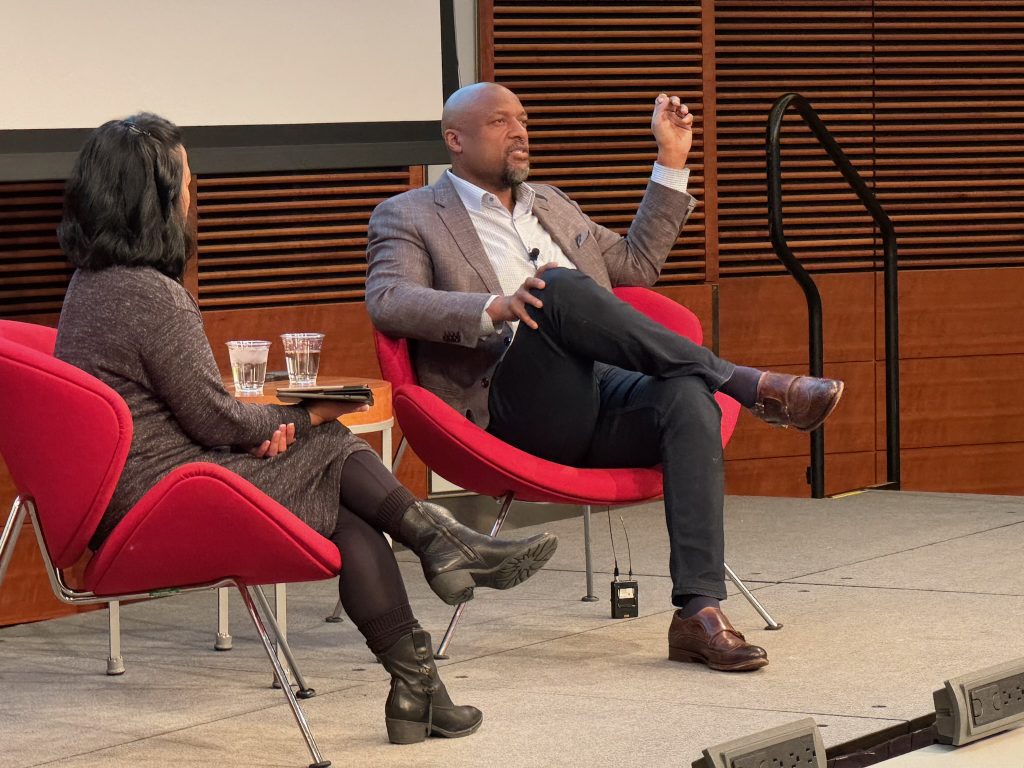
Provost Charles Isbell joined the Information & Technology Leadership Conference on December 5 for a conversation about his vision for UW’s future and how the university and higher education will evolve in the coming decades. (Photo by Nick Heynen / DoIT Communications)
It used to be in 1983 when you had an idea, you went to the library, you knew it was an original idea, and then you went and published something. But now you have an idea, you Google it, and there’s like 17,000 people who had pretty much that idea, and you don’t know what to do with it. And that causes all kinds of interesting side effects to the way you think about doing research and education.On the other hand, it hasn’t changed anything at all. We have not adapted to the potentials of the technology that we have in front of us to rethink the way that we fundamentally should be doing education.
Probably along the same lines, then: You’ve spent much of your career researching machine learning and artificial intelligence with an emphasis on developing adaptive technologies for human-machine collaboration. What opportunities and challenges do you see AI presenting for higher ed institutions in the future?
Again, it changes everything and nothing all at once. If we don’t use magic words like machine learning and AI, and we just think about it as computing and data, then the fact that everyone has access to all that compute and all that data impacts everything that we do. The way I like to think about this is: AI and machine learning (which is a thing that I do, and I think is the single most important thing in the world) it’s just computing. It’s just networking and computing. And when you ask questions about how AI or machine learning matters or what it does, you’re really just asking, “Do computers matter?” And the answer is clearly yes. “Does networking matter?” The answer is clearly yes.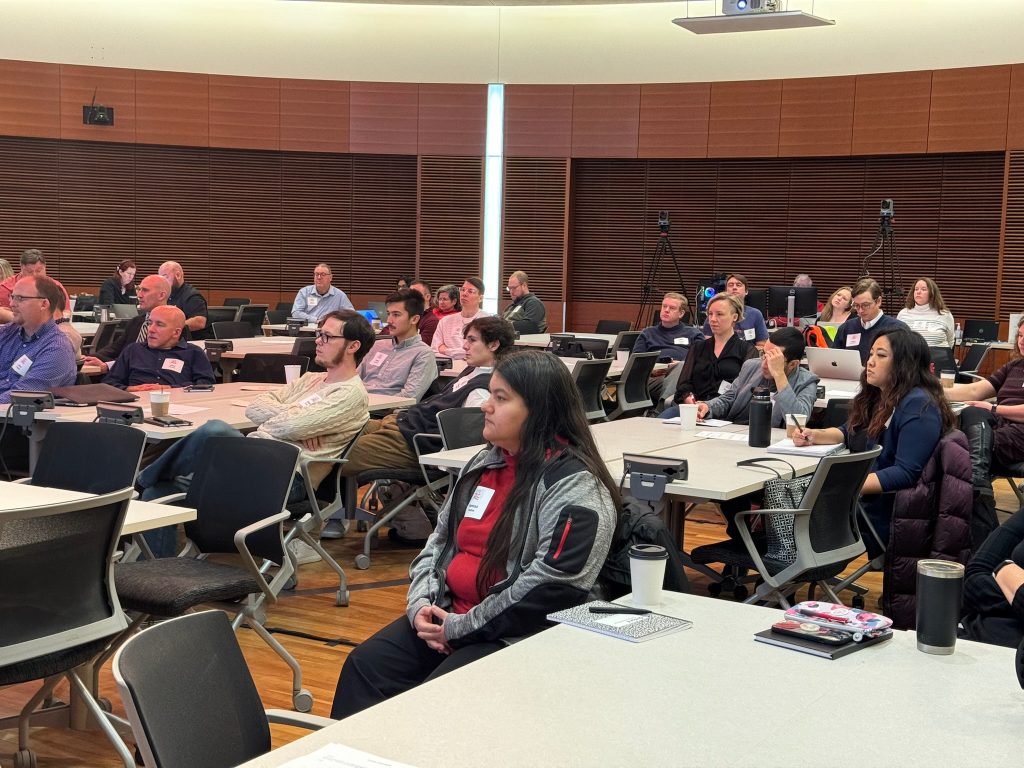
Nearly 250 people attended the hybrid Information & Technology Leadership Conference. (Photo by Nick Heynen / DoIT Communications)
What advice would you give to someone in the 1st half of their higher-ed IT career who is interested in exploring leadership opportunities at the university?
The main thing you have to do if you want to go down thinking about leadership is to figure out who you are, what really matters to you, what your North Star is, what kind of person you are. How do you want to lead as a fundamental and basic idea? Why are you doing this at all? What I believe is that higher education is in the middle of a massive crisis with respect to the body politic, with the way that it thinks about itself, with the massive demographic shifts. Everything is different. And we have a model that is hundreds of years old that has not adapted to either the present or the future that’s clearly coming. There are a small number of universities that are positioned to do something about that. And I want to be at a place like that. I want to be in the room and help to lead the conversation. If that means being provost of a land-grant university with 50,000 students and 33 direct reports, that’s the right thing to do. If it means going over here in a room and doing something different around HR, then that’s fine, too. However you get from here to there, but that is the reason why I want to do what I do. Having a vision of yourself—understanding why you’re going down this path and where it ultimately could lead you—is the very 1st thing you have to do. You have to figure out: “This is what I care about. This is the thing that matters. This is the thing that I might be able to impact and affect.” Why would I trade doing the things that I enjoy, whether it’s programming or building systems, why would I trade that off for being further and further away from the problems themselves, but in a place where I can affect more and more human beings so that they can solve these problems? You have to have a reason to do it besides the next title or the next bump in pay, because that just doesn’t get you through the difficult times. It has to be: there’s a big red circle up there [points to red circle on the ceiling], and that’s where I’m heading, and I’m going to keep walking towards that circle and just have to figure out what that circle is.Audience question: What do you see as the most promising opportunities for IT to support change at UW–Madison?
You can think about it as purely an infrastructural question, or you can think about it as an educational question. So let’s try to do both of them. In terms of infrastructure, fundamentally, the engine that drives all the innovation that’s coming out of the university is going to be IT. That’s fundamental. There’s no way around this. It’s as important as the utilities. It’s as important as the fact that the heat is on in this building. Purely as a matter of infrastructure, nothing can work without it. But there’s also a question of kind of innovation and expertise. The real opportunity here—whether it’s educational, supporting research, or the everyday business needs of the university—is understanding how to take the expertise that you have and make certain that people make decisions that take into account both the promises and the threats of the proper use or misuse of technology in what they’re doing. Because people don’t think about that. They don’t understand. You have people who are making policy decisions who fundamentally don’t actually get the consequences of shoving this piece of technology in or not doing this thing right or wrong. For me, the opportunities here are less about getting the particular piece of technology in and getting it working, although that is a necessary but not sufficient condition. It’s making yourself a part of the conversation so that people can make reasonable decisions given the reality of where the technology is and where the technology is going. That’s where the innovation lies. That’s where the opportunity to change direction actually comes from.Audience question: Can you share some of your thoughts about the role of non-technical disciplines or their relationships to IT?
I did my undergraduate degree in information and computer science at Georgia Tech. I minored in history, Spanish and cognitive science. I am very much a believer in the integration of all aspects of education into what we do. Education, particularly in an environment like this, is about getting people to think differently. You’re way down here [gestures with hands] when you’re thinking about toolsets. “IT is a tool that I’m going to use,” or “I’m going to use Git” or something. And then you start moving to skillsets [raises hands higher]. But you don’t actually make the transition you want to make until you start thinking about mindsets [raises hands higher]. To me, it’s not possible to solve the kind of problems we want to solve or to think about the things we want to think about unless we bring together lots of different mindsets and, in particular, expose the people who are building the technology into thinking that way. The mistake that many of us make is we think that we try our best—and there are good reasons for this—to think about the problem as being here [holds hands close together]. We don’t worry about what came before, and we don’t worry about what’s going to happen after. That makes things easy to think about, but it breaks everything fundamentally at the end. You’ve got to have this broad notion with people with different ways of thinking coming together to solve your problem, or it all breaks down.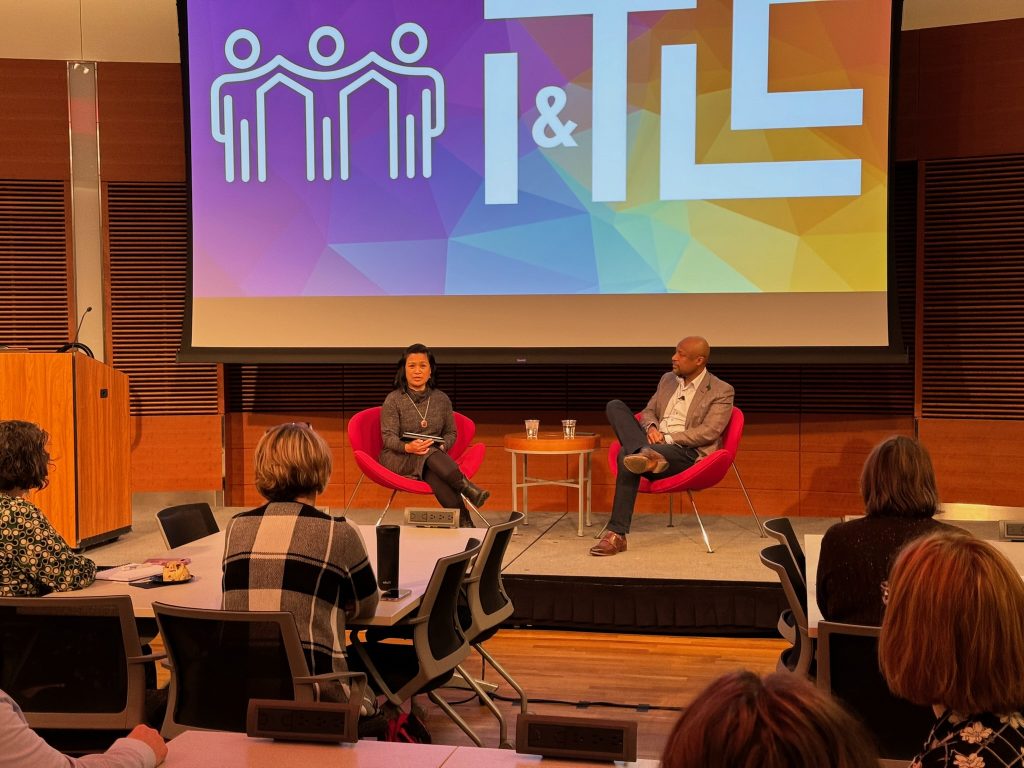
In a lively and wide-ranging 45-minute fireside chat with I&TLC co-chair Leah Meicher, assistant director of Student Enterprise Applications in the Registrar’s Office, Provost Isbell discussed his leadership style, engaged with audience questions, and emphasized the importance of interdisciplinary collaboration, bringing diverse perspectives into decision-making, and ensuring technology responsibly serves all people. (Photo by Nick Heynen / DoIT Communications)
People often talk about invisibility when they talk about diversity. Invisibility is often expressed as “you’re in front of me, and I don’t see you,” but this is not actually where we get into trouble. The invisibility that gets us into trouble is “you’re not in the room, and I don’t notice your absence.” The set of people who needed to have been in the room, who would have said immediately, “Why don’t we test this on Aretha Franklin,” just weren’t in the room. And so the question never got asked, and no one noticed until it was too late. It was a leadership question.What this means, as you’re trying to get people to work on big things, whether they’re technical or not, is you have to find ways to bring the right set of people in the room, to always be aware of who isn’t in the room that you forgot about, and who would drive the set of questions that would lead to a better piece of technology. Staying here [holds hands close together] and ignoring everything that came before and everything that goes after is guaranteed to get you embarrassed. It’s guaranteed to make things not just kind of silly but to build systems that will actively harm people, and nobody wants to be a part of that. So, the leadership question is a question that’s fundamentally about responsibility. People will often frame it as ethics, but it’s not an ethical—I mean, it is, but really it’s a responsibility question, and fundamentally it’s a leadership question. What does it mean for you to think about how you’re going to build a system that’s going to be touched by 8 billion people and is going to go to places you’ve never really conceived of? How do you minimize the danger that comes from that? How do you bring people into the room to have the conversation and have the difficult conversations that are going to happen as you bring people from very different backgrounds together to work on a problem, and have completely different views of what’s good, bad, or indifferent?